The Oxford Shirt is the most misallocated piece in a professional wardrobe. Most men buy it as a weekday shirt, wear it to the office under a suit jacket, and quietly conclude it does not quite work. Then it hangs unused at the weekend, when it is exactly the shirt the weekend needed.
This is a distribution error, not a design error. The Oxford has a specific brief; it works across pubs, country houses, hotel bars, airport lounges, and any room where the dress code is implied rather than printed. It does not work, well, anyway, under a Savile Row two-piece at a Tuesday morning pitch. The cutaway poplin has been the Magic Circle weekday shirt for thirty years, and the market is not going to correct itself on a random Tuesday.
This is a guide to where the Oxford earns its keep. The office question settled properly, then the country, the travel, the dinner, and the specific afternoons where a poplin would cost a man something and the Oxford would not.
The Office Question: Why Poplin Still Wins Monday to Thursday
The Oxford's office reputation is, on closer inspection, American. The button-down collar was copied at Brooks Brothers in 1896 from English polo players who pinned their collars to stop them flapping in the wind. An origin story that flatters on the label and loses its charm when held next to a Savile Row lapel at 8am in The City.
In traditional finance and law, the Oxford is a Friday shirt, a travel shirt, or a layering shirt. It is not the shirt for the client pitch. The cutaway poplin takes a tie, takes a collar stay, and photographs well under fluorescent lighting. The Oxford photographs well under everything else.
In Mayfair, the poplin reads as "I do Big Law." The Oxford reads as "I left Big Law." The linen reads as "my wife's money." These are three different positioning statements being made across the same restaurant at the same lunch. The man in the Oxford is the one the other two are trying not to look at.
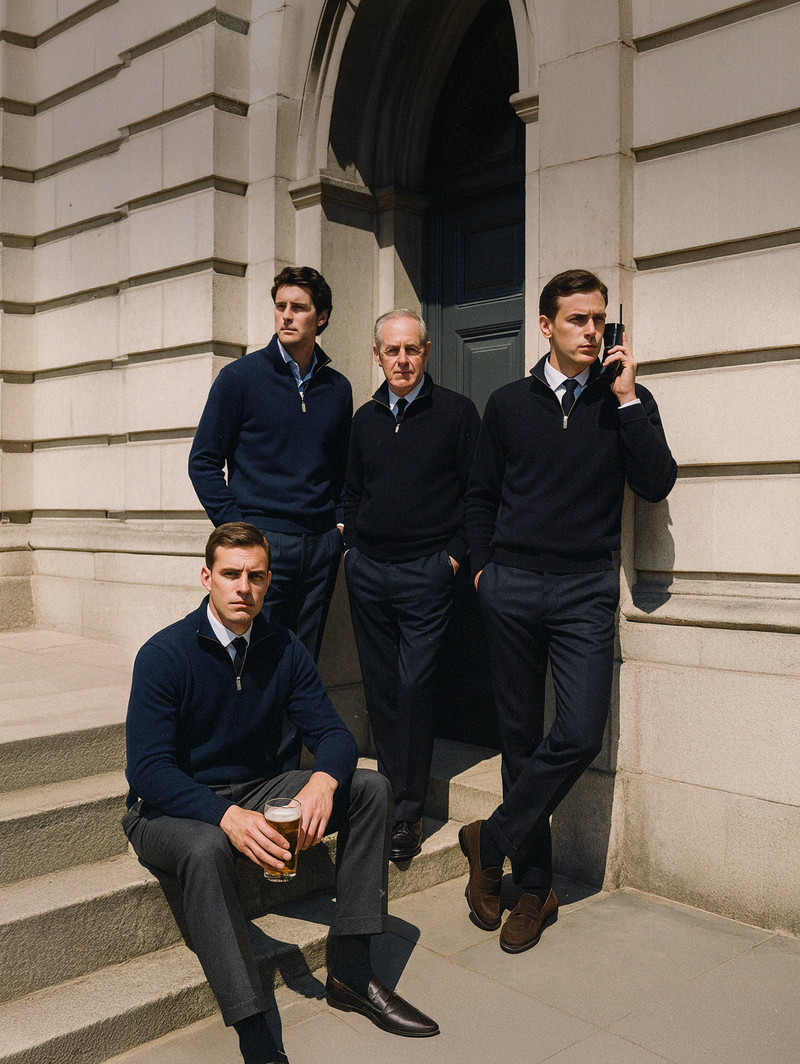
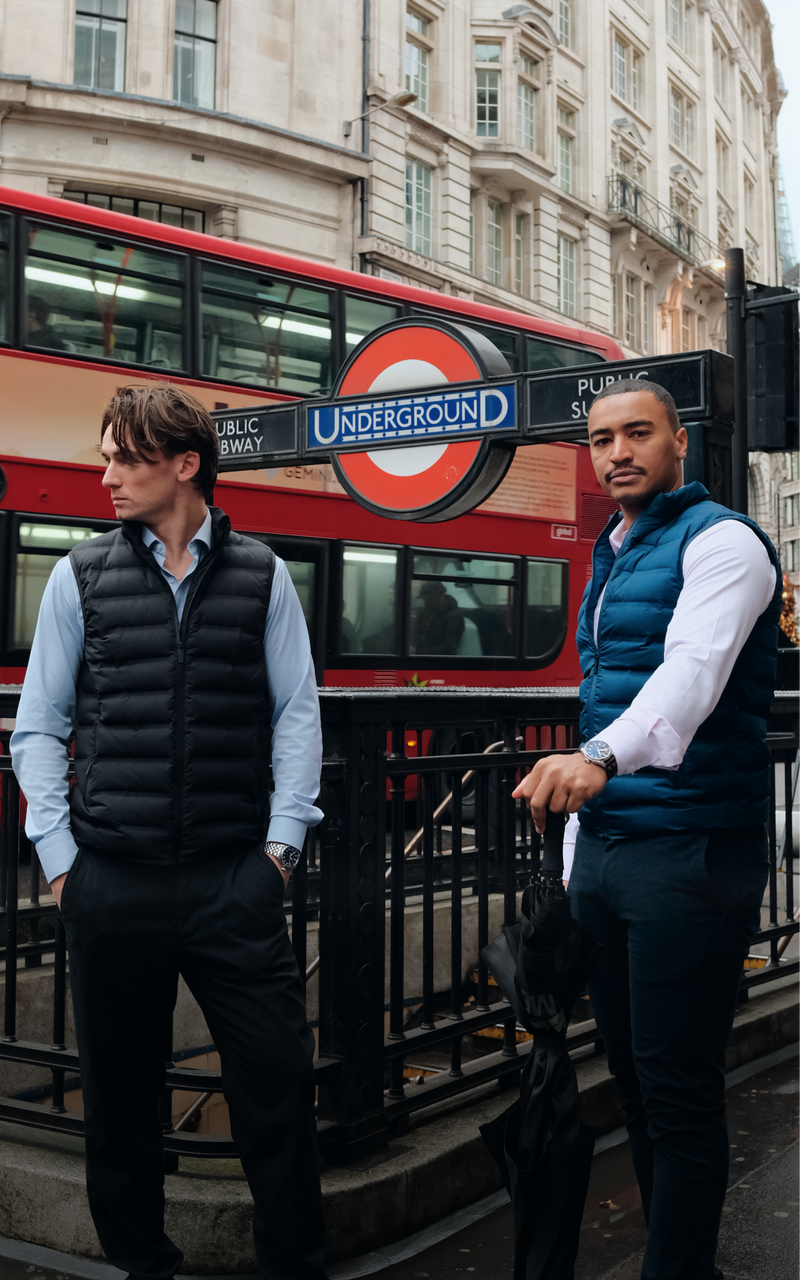
The exception is the boardroom-hybrid office, where knit-over-shirt has quietly become the uniform. Here the Oxford works as the collar anchor under a Merino Wool Quarter Zip, which sits under a gilet when the air-conditioning wins. The collar peeks, the knit hides, the gilet carries the structure. The combination is the most duplicated outfit in every WeWork in Soho. The duplication is the whole point. Uniforms reduce decisions. Fewer decisions free up processing for the ones that bill.
A Shirt, Quarter Zip, and Gilet are the holy trinity of business casual. The Shirt is God.
The Best Country Weekend Shirt
The Oxford is the only shirt on the rail that survives a weekend bag. Poplin creases without apology. Linen is a summer-only argument. Twill shines under country-house lighting and looks borrowed. The Oxford is heavyweight enough to hand-press after unpacking, structured enough to hold a collar through a pub lunch, and forgiving enough to survive a Labrador called Ralph, Monty, or Saffron depending on whose house the weekend is at.
The setting is the drive to Oxfordshire on a Friday, the stop at a pub with low beams and a menu that has not moved since David Cameron was PM, the walk across a field nobody technically owns, and dinner with a father-in-law who believes rates should be higher, has believed so since 2010, and has held Unilever for longer than most hedge funds have held conviction on anything. He will not be corrected on either, and the shirt should not try.
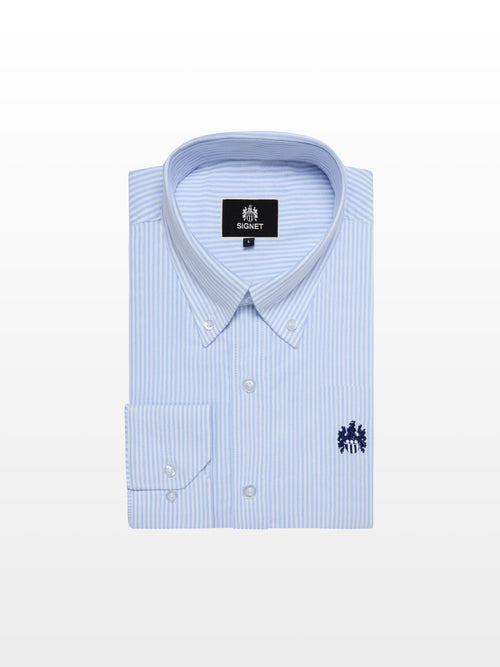
The acceptable country palette is narrow. White, Blue, Pale Pink, and Bengal stripe in blue or pink. The button-down collar is correct here in a way it rarely is in London. The cuffs are one-button barrel, not French. Sleeves up over the elbow for the walk. Rolled once and flat otherwise. Tucked into wool trousers for dinner. Untucked over stone chinos for the afternoon. The Oxford is the shirt of men who read the FT Weekend and mention it.
When the walk gets cold, a Suede Gilet goes over the top. The shirt collar stays visible above the neckline, which is how a Saturday afternoon reads as country and not as fleece.
The Best Travel Shirt
The Oxford travels better than anything else in the wardrobe. It crushes into a packing cube, steams in a bathroom, and lands on the body without a pressing bill. Worn with loafers, tailored chinos, and a linen blazer on the hotel leg, it reads as a man who arrived, not a man who is arriving.
In Monaco, walking suggests humility. Or worse, liquidity issues. The country is roughly the size of a Waitrose car park, and the net worth per square metre is high enough to make Mayfair feel accessible. Monaco's main import is British men who used to pay UK capital gains tax. The crypto crowd who arrived alongside them in 2021 have since been replaced in the hotel bars by Americans with residency paperwork and a new view on Washington. The shirt reads the same on all three cohorts. A heavyweight cotton in white or pale blue, tucked, with a linen-wool trouser and a loafer, does the whole leg. A Maserati, parked facing outward so that walking anywhere appears unnecessary, does the rest.
In Zurich, where a meaningful percentage of the business-class cabin has spent six months on weight-loss injections, the summer-body bar has shifted from "don't be fat" to "have shredded abs." The shirt that hung loose last year is tailored by circumstance. A heavyweight Oxford that skims the frame without clinging is the quietest fix. There are three kinds of men in Zurich: the ones moving money, the ones moving reputations, and the ones there for a weekend because their wife is at a wellness retreat in the hills. The shirt is how they recognise each other across the hotel bar without speaking.
In St. Moritz, where wearing anything off-the-rack is as taboo as paying taxes, the Oxford is the casual piece that survives the snow polo, the Kulm lunch, and the car from Badrutt's to dinner without a change. Snow polo has rules. Most of the crowd does not know them. Clapping at the right moments is the whole competency, and the shirt should not draw attention away from the clap. An Oxford Shirt holds rooms the custom knit was never going to walk into.
The Perfect Dinner Shirt
The Oxford is the only shirt that arrives at the restaurant still looking considered after eleven hours. The dress code is implied. A dinner with a guest list, an 8:30 table somewhere with a set menu and a doorman, a black cab home. The shirt lands with the collar still rolling. The tie is no longer in the room. The cuffs are buttoned.
A man in a poplin at a 9pm table looks as if he has been called to account. A man in the same shirt he wore to the desk, untucked, with the tie removed and the top button undone, reads as a man who did not need to change. The difference is legible across the table, and it is how the bill eventually splits.
The shoes are loafers or suede chukkas. The trousers are wool, not chinos, for anything past a Wednesday. The watch is on show but not discussed. A Garmin on display under a barrel cuff at this table would be a cry for help. This is a room where the shirt does most of the work and everything else stays in the background.
The Argument For Oxford Shirt Fabric
The Oxford weave is what separates the shirt that holds all of this from a shirt that looks borrowed by 4pm. Heavyweight cotton, garment-washed, with a button-down collar that rolls rather than stands, and a split back yoke for movement. The British cut sits at the edge of the shoulder, not two inches down the arm. The hem lands at mid-hip untucked. Sleeves end at the wrist bone.
Anything lighter drapes wrong on any man over thirty. Anything synthetic shines under office lighting and clings after lunch. The entry-level polyester-blend Oxford, sold in packs of three at Primark, is the shirt that adds three kilos to a man and tells the table he is economising. Every Oxford in a three-pack has the same provenance: a contract factory in Bangladesh, a trader with a quota, and a buyer who has never had to wear one past 6pm.
Garment-washed is the detail that pays compound interest. A new Oxford is an Oxford nobody has earned yet. The wash takes a year off the front, so the first wear lands like the tenth, and the tenth lands like the hundredth. The hundredth is still in rotation by the time the junior who joined the same week is running a desk of his own. Or has left to build his B2B AI SaaS Startup. Either way, the shirt remains.
Mistakes That Undermine the Oxford Shirt
Worn with a T-shirt underneath. The collar is the whole argument. A crewneck at the neckline turns the shirt into a thermal. Every men's magazine between 2014 and 2019 told men to do this. It was wrong then. It remains wrong now.
Ironed flat at the collar. The roll is the tell. A flat collar reads off-the-peg at John Lewis. A rolled collar reads like a shirt that has been worn properly.
Oversized. The shoulder seam sits at the edge of the shoulder, or the shirt belongs to a larger man. The conclusion is visible across a table, and it reflects on the diner, not the tailor.
Screen-printed branding at the chest. A Ralph Lauren polo player is fine at 19 and on holiday. Past 28 it reads as a man who has not updated his wardrobe since the recession. A discreet embroidered crest is a signature. The brand signing the work and the brand being the work are different pieces of tailoring entirely.
Worn to the gym. Indefensible. If attention is the goal, run a marathon. If attention is not the goal, run a marathon anyway.
When an Oxford Is the Wrong Call
Black-tie. The dinner jacket takes a pleated formal shirt with stud buttons. Oxford cloth is not correct anywhere near a black-tie invitation. This is a rule. It is not up for review.
A client pitch at a Magic Circle firm. The external-persuasion shirt is a crisp poplin. The Oxford is internal credibility. The brief was not a suggestion.
Ascot Royal Enclosure. The morning suit takes a formal shirt with a stiff collar. The Oxford stays in the country-house wardrobe until the bet-your-ISA-on-a-horse afternoon is over and the champagne tent has won.
A heatwave in Cap d'Antibes. A heavyweight cotton in August on the roof at Eden Roc is the shirt of a man who has not taken a holiday in eighteen months. The linen shirt exists for a reason. So does the holiday.
A funeral. The Oxford is not white enough and not stiff enough. A plain white poplin, pressed properly, is the entire answer. This is not the room for innovation.
The Verdict
The Oxford is not the weekday shirt. It is the weekend shirt, the travel shirt, the hotel-bar shirt, and the dinner shirt. Worn in those rooms it works quietly and holds position from morning coffee to the last cab home. Worn on a Monday under a suit jacket at Canary Wharf, it reads as a shirt in the wrong room. Which is also, quietly, a career warning.
The shirt is not trying to prove itself. Everyone else at the table is.
Subject, as ever, to the room.